

When buying a used offset press, most buyers focus on cylinders, gears and top speed, while safety devices are waved away with a casual "it starts and runs". That is exactly where the traps are buried: one bypassed interlock switch missed at inspection can turn into an entanglement accident after commissioning, or a costly retrofit bill. This article provides criteria you can execute on the spot: how to spot modification and bypass traces, how to test interlock logic live, how to re-verify sensor gaps, how to read an E-stop reset failure, and what standard applies to delivery pile lifts. The benchmarks follow the manroland press safety document (number 80 95A ZH D122, 2010 edition), the Heidelberg perfecting safety-devices booklets, and Heidelberg's April 2008 supplemental delivery-safety requirements.
- The manufacturer's position is unambiguous: without explicit permission, no modification, additions or refurbishment is allowed, and changes to software, machine parameters or the electrical control system are prohibited — bypassing a safety switch is not a tuning trick, it is an unauthorized conversion.
- Parts marked "S" in the original parts catalogue are safety components built to machinery-safety directives; replacements must be original equivalents. Substituting a standard relay for a safety relay should be a deal-breaker at inspection.
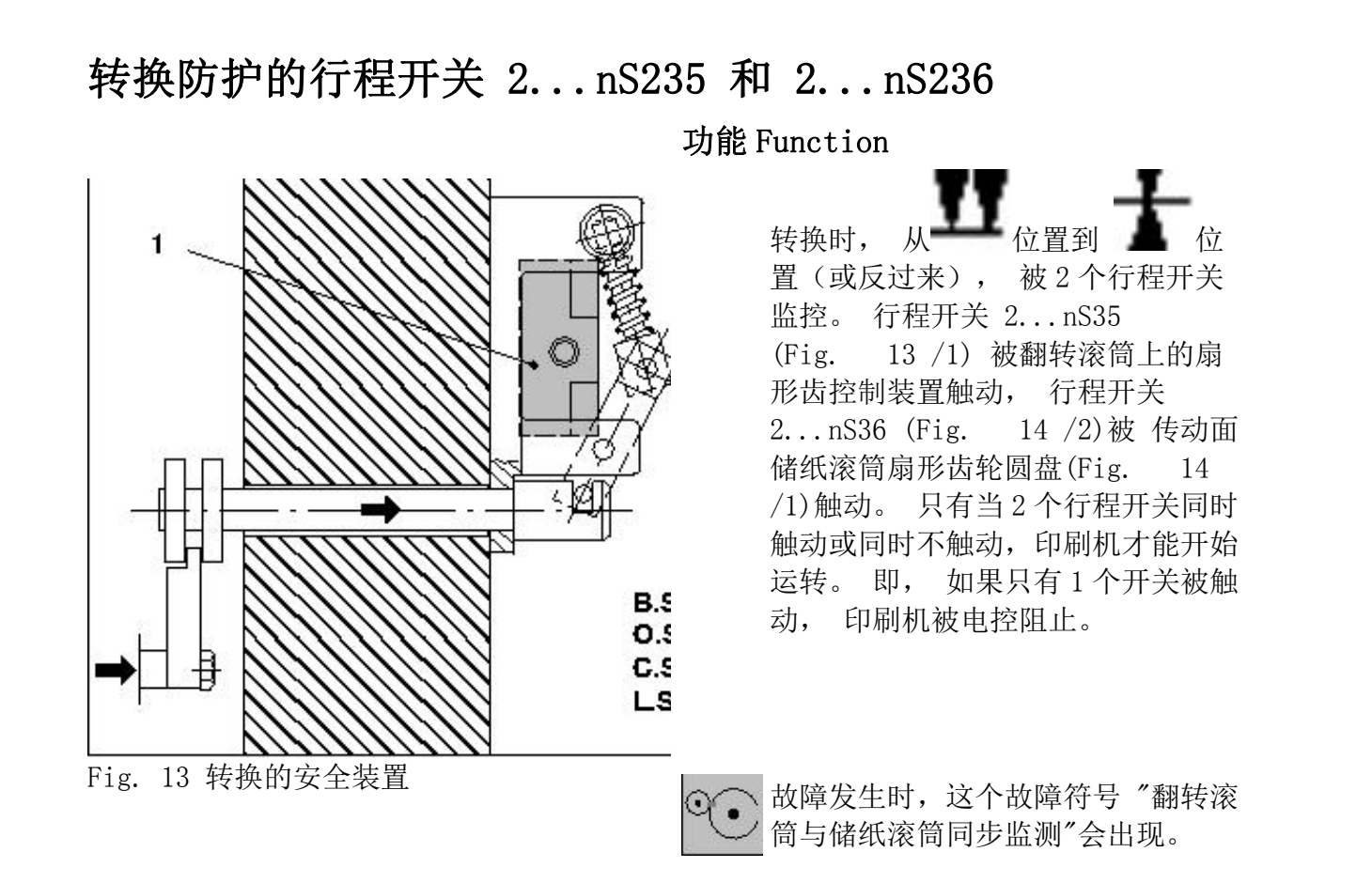
- Test interlocks live, do not take verbal assurances: changeover between the perfecting and storage cylinders is monitored by two limit switches, and the press may only run when both trip simultaneously or both stay untripped; pressing only one must be blocked electrically.
- E-stop reset failure is the most common hidden fault: with no output from the safety relay, the main contactor feeding the inverter never pulls in, so the press looks powered but refuses to start.
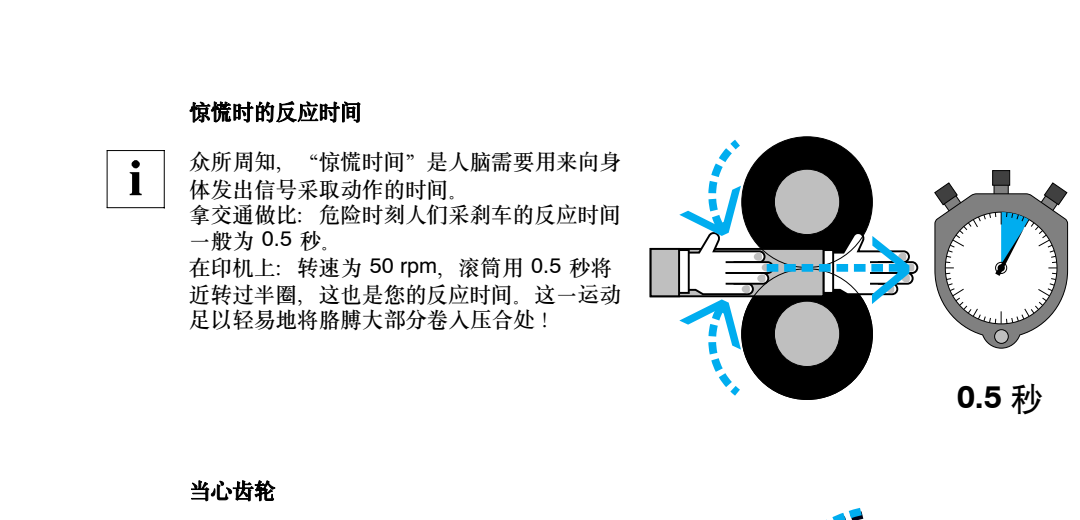
- Exercise every E-stop button and every guard switch one by one; also expect coasting — at 50 rpm the cylinder still turns nearly half a revolution within half a second.
- Verify feeder and delivery pile lifts daily before start-up: nobody may stand fully or partially beneath a raised pile, piles go to lowest position at shift end, and work under a raised pile requires an emptied pile plus certified supports.
1. Check for modification and bypass first
The original safety document is firm: operators and technical managers must check all safety devices every day, and defeating protective equipment is strictly forbidden. For a used-machine inspection, that daily-check requirement is the buyer's entry point — ask the seller for recent safety-device check records; if none can be shown, raise your guard. Look at three spots: first, whether rating plates and warning labels are complete and legible (the maker requires them to stay readable and unmoved; missing plates suggest rough use or refurbishment); second, the safety circuit wiring inside the cabinet, especially shorting bars or jumper wires across the safety-relay outputs; third, whether guard-switch strikers have been tied or shimmed so the switch sits permanently "closed", which makes the interlock decorative.
2. Test the interlock: one switch must be able to stop the start
Take the changeover protection of a perfecting unit as the example: the conversion is monitored by two limit switches, one tripped by the sector-gear control on the perfecting cylinder, the other by the sector-gear disc on the drive-side storage cylinder. The original logic is blunt: the press may start only when both switches trip simultaneously or both remain untripped; if only one is tripped, the press is blocked electrically and the console shows the "perfecting-cylinder / storage-cylinder synchronism monitoring" fault symbol. Do the reverse test on site: press one switch manually and command a run; the machine must refuse to start with the synchronism fault. If it runs anyway, the interlock has been bypassed, remediation involves rewiring, and cost and downtime belong in the price negotiation.
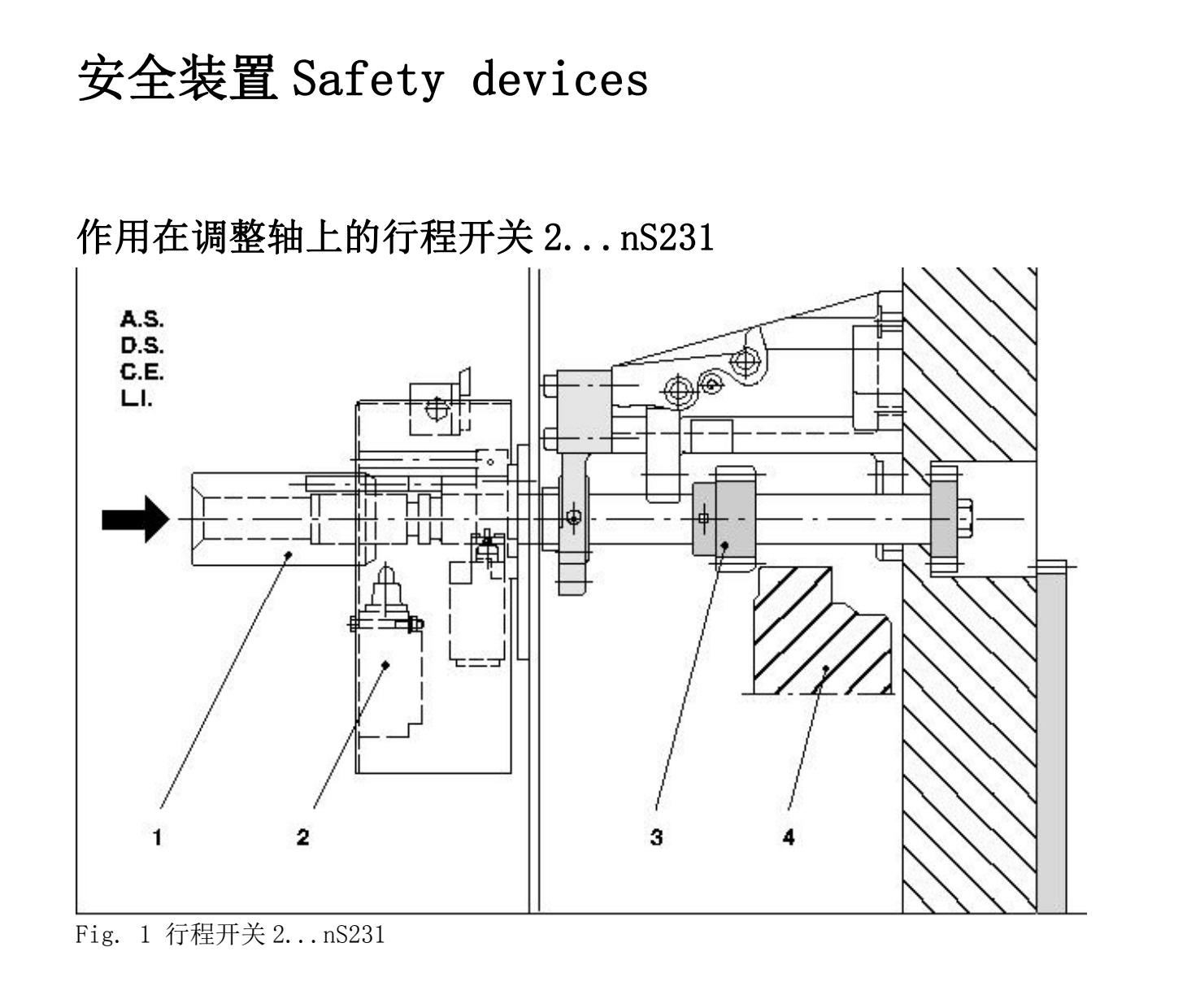
The limit switch on the adjusting shaft has its own threshold: it must trip just before the pinion engages the storage-cylinder gear, with the switching point pre-compressed 1 mm before meshing. A badly positioned switch turns the barring handle into a hazard. Feel is a first screen: switches with overshoot or dead travel were probably never maintained to spec. Also verify the three-position logic of the adjusting shaft: fully inserted for size changeover only, mid-position for barring, fully withdrawn before the press may run.
3. Gaps and reset criteria: argue with millimetres
Acceptance of safety sensors is not just "does the LED light" but "is it positioned right". Factory tolerances are explicit: the stop-lever sensor sits 1 ± 0.1 mm from the lever and must detect it within 1.4–1.6 mm of lever travel; the locking pin-to-bushing gap of the adjusting shaft is 1 ± 0.2 mm; the base-to-storage-gear distance is 1.6 ± 0.3 mm; the position sensor on the format-change hook cylinder is set by moving it until the LED lights, then another 1 mm in the same direction before tightening. A feeler gauge and a few gauge blocks let you re-check all of these on the spot. Missing-sheet detection can be tested live: cut one sheet 5 mm short, square it at the pile front edge, lay ten full-length sheets on top and run paper — after the tenth sheet the sensor must respond; if not, suspect a dirty sensor, a misaligned reflector or sensitivity drift, then re-test after correction.
4. E-stop circuit and safety relay: read the chain from a reset failure
A real troubleshooting record shows the causal chain plainly: when the safety relay in the emergency-stop circuit fails to reset, it produces no output, the main contactor feeding the inverter power cannot pull in, and the press appears powered yet will not start. Start such a check with the supply format: three-phase 380 V, 50 Hz, incoming lines R, S, T, N, PE; a missing PE or mixed neutral-earth wiring destabilizes the safety circuit. The inspection routine is plain: press each E-stop button in turn, confirm the main contactor drops out, and confirm the press may restart only after reset. Treat any single failed E-stop as a major defect, and refuse the excuse that "that button is never used".
Be equally clear about stopping: when a guard trips, power is cut, but cylinders and rollers keep coasting — at 50 rpm the cylinder covers nearly half a revolution in 0.5 seconds, enough to draw most of an forearm into the nip. Hence the discipline of inch — check — operate: inch to position, stop, verify, then adjust; never open a button a colleague has locked out, because locks and tags are part of the maintenance-safety chain.
5. Pile lifts: the most overlooked corner of the delivery
In April 2008 the manufacturer issued supplemental safety requirements for presses fitted with the enhanced preset feeder and enhanced preset delivery, covering configurations such as SM/CD102 and XL105. Five points: nobody may stand fully or partly beneath a raised pile in the feeder or delivery area; lower the pile fully before maintenance or cleaning; check correct pile travel daily before start-up and report faults immediately; at shift end or end of production lower the pile to the lowest position, even when empty; where work under a raised pile is unavoidable, empty the pile and fit supports of sufficient strength underneath, then test by lowering the pile onto them. Run a used machine through these five points and the state of pile lift, limit switches and pile support tells you how the press was really maintained.
| Check | Method | Pass criterion |
|---|---|---|
| Guard switches | Open any guard while running | Immediate stop with console alarm |
| Changeover interlock | Press one limit switch manually | Start refused with synchronism fault |
| Stop-lever sensor | Feeler check at 1 ± 0.1 mm | No false trips, no missed trips |
| Missing-sheet detection | 5 mm-short sheet plus ten full sheets | Sensor responds after the tenth sheet |
| E-stop buttons | Exercise one by one | Contactor drops out; restart only after reset |
| Pile lift | Run empty and loaded | Full travel, valid limits, no abnormal noise |
Three common misjudgements: treating "it starts" as a proof of interlock health without the single-switch blocking test; reading a safety-relay alarm lamp as a bad connection and tapping it back into service, when reset failures usually trace to the E-stop chain — check supply and incoming wiring first, then button and guard continuity; assuming that adding hardware fixes everything, when the maker requires "S"-marked safety parts — substituting standard parts simply turns a hidden hazard into a labelled one.
Discipline at the inspection site matters too: stop the press and prevent others from restarting it before touching any moving part; live electrical checks belong to a licensed electrician with a second person who can cut power at any moment, on insulating mats with proper tools; switch off the dryer and let temperatures fall before washing rollers and cylinders; keep mobile phones and similar devices at least ten metres from the press to avoid radio interference with control signals.
As for the frequent questions — "can safety devices on a used press be bypassed?", "why does the perfecting unit keep reporting a synchronism fault?", "can a press with a faulty pile lift keep running?" — the answer is the same: shorted interlocks, muted faults and degraded operation save a few days of downtime and gamble the safety of the whole line. When nuisance trips pile up, re-verify sensor gaps against tolerance and trace the E-stop circuit against the supply format before replacing parts. For component-level acceptance criteria, continue with our guide to perfecting configuration inspection; for model comparison while shortlisting, filter used printing equipment in stock by brand and colour units.
Conclusion: Safety devices are the one section of a used offset press inspection where a fail is a no-go. Read tampering from the cabinet and strikers, read interlock health from the single-switch blocking test, read sensor condition from millimetre-level tolerance checks, read the E-stop chain from reset behaviour, and read pile safety from the five supplemental requirements — five steps, and the machine's maintenance culture is written on its face.