

In November 2026, Chinese-built presses appeared alongside an imported classic on the disposal stage: at an auction in Gaotang, Shandong opening on November 19, two Changsheng CSS920 sheet-fed duplex single-color offset presses, built around 2018, went under the hammer with a starting price of 250,000 yuan; in the same window, a 2012 Heidelberg four-up six-color press owned by a Dongguan packaging company entered a re-auction procedure. The second-hand circulation of domestic folio-format presses is turning from isolated cases into a monthly observable batch pattern. Based on facts disclosed in the auction notices and real technical data of two generations of Beiren folio presses — the J2108 and the JS2102A — this article sets out the technical fundamentals of domestic duplex presses, their control-system generations, and a hands-on inspection checklist in one pass.
- Four verifiable November lots span three channels: the two Gaotang CSS920 presses (overall asset auction on the China Auction Platform, deposit 20,000 yuan, viewing November 16–17); the Dongguan Zhanrun 2012 Heidelberg four-up six-color press (re-auction on the Ali-assets bankruptcy platform, 10:00 November 19 to 10:00 November 20); a batch of Huizhou packaging press equipment (court execution on the JD platform, reserve 28,870 yuan, starting bid 20,300 yuan, deposit 4,060 yuan, 10:00 November 23 to 17:00 November 24); and 108 scrapped assets of a Xinjiang chemical company listed on the Beijing Equity Exchange, including scrapped offset presses and a batch of four-color folio presses (transfer floor price 379,460.27 yuan, listed October 29 to November 6).
- Nameplate photos attached to the notice show the two CSS920 units carry serial numbers 80178 and 180108 with production dates of January 2019 and May 2018, a maximum sheet size of 650×920 mm and a paper range of 55–200 g/m² — matching nameplate to notice is the first step of any viewing.
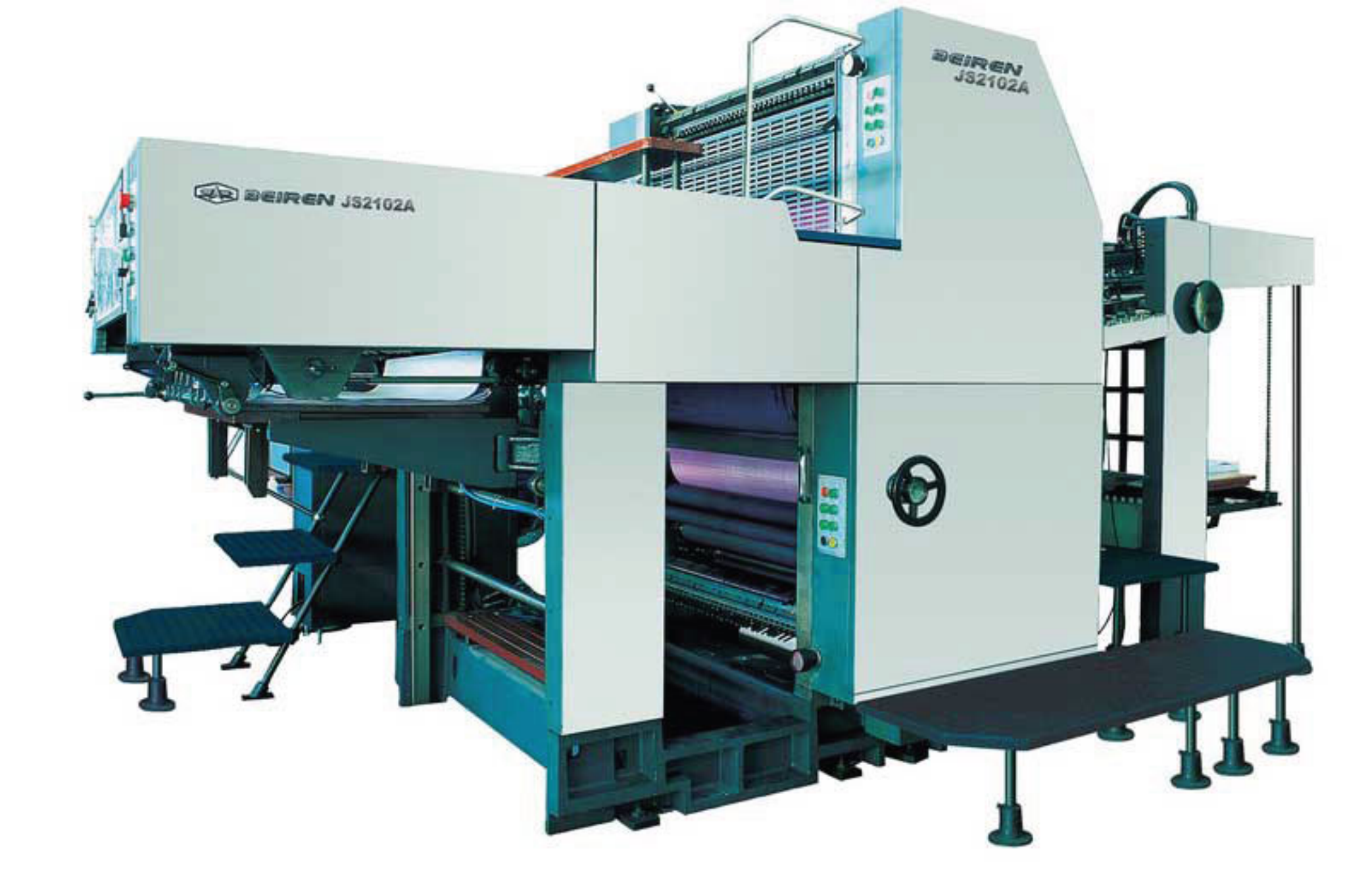
- Specification data of the JS2102A, the representative domestic duplex folio press: max sheet 650×920 mm, min sheet 393×546 mm, paper thickness 0.04–0.2 mm, max image area 638×920 mm, rated speed 9,000 sheets/hour (a design ceiling that varies with printing conditions and materials), main motor 11 kW, total connected power 23 kW, machine weight with feeder about 10,300 kg, footprint 4610×2910×2460 mm.
- Duplex printing relies on an upper/lower blanket-cylinder arrangement: upper blanket 960×840×1.95 mm, lower blanket 960×860×1.95 mm; three plate-inking rollers of 70, 75 and 80 mm diameter and two plate-dampening rollers of 64 mm diameter.
- The control generations are traceable: the J2108 electrical system fixed around 1999 runs on three-phase four-wire 380 V, 50 Hz supply, with a 7.5 kW inverter-driven main motor using off-line (power-cut) braking, PLC-based control, and a speed range of 4–106.6 rpm equal to 10,000 sheets/hour; the 2006 JS2102A already combines PLC, HMI, encoder and stepless inverter control, with supply-voltage fluctuation limited to ±10% and a power capacity of at least 40 kVA.
- Verify the stop interlocks before talking about speed: the JS2102A stops automatically on double sheets, blanks and skew, and stopping triggers ten sequenced interlocks — feeder stop, blanket and plate cylinders separating in order, front-lay oscillation stop, counter stop and more. Triggering each one beats listening to noise for finding hidden faults.
1. The November disposal landscape: three channels, four disposal contexts
Put the four lots in one table and the pricing logic stratifies immediately:
| Lot | Channel and platform | Timing | Price elements |
|---|---|---|---|
| Two Gaotang CSS920 presses (overall auction) | Overall asset auction, China Auction Platform | 09:30, November 19 | Starting price 250,000 yuan, deposit 20,000 yuan |
| Dongguan Zhanrun 2012 Heidelberg four-up six-color | Bankruptcy re-auction, Ali assets | Nov 19 10:00 – Nov 20 10:00 | Re-auction procedure, no floor price published |
| Huizhou Yimei packaging press batch | Court execution, JD platform | Nov 23 10:00 – Nov 24 17:00 | Reserve 28,870 yuan, start 20,300 yuan, deposit 4,060 yuan, increment 300 yuan |
| 108 scrapped items incl. offset presses (Xinjiang chemical company) | Exchange listing, Beijing Equity Exchange | Oct 29 – Nov 6 | Floor price 379,460.27 yuan, deposit 100,000 yuan |
That is the factual layer. On judgment: a re-auction usually means the previous round failed to sell, so price expectations can move down; court-execution lots start below the appraised value and can close well under it; exchange-listed scrapped bundles are priced by batch, not by unit, so quality varies widely and rewards buyers with in-house refurbishing capacity. The channel sets the context, and the context should set the bidding strategy — applying judicial-auction discipline to a scrapped bundle, or the reverse, is a lesson paid in real money.
2. Technical fundamentals of the domestic duplex folio press: the JS2102A as a specimen
The Changsheng CSS920 and the Beiren JS2102A belong to the same class of folio single-color duplex offset presses with a 650×920 mm maximum sheet, aimed at printing paper, light coated stock and newsprint in a single-pass duplex mode, typically for book and magazine text work. Three drivetrain traits disclosed in the technical documentation deserve focused checks during inspection. First, the lower plate cylinder, upper blanket cylinder and intermediate transfer cylinder ride on high-precision sliding bearings, while the upper plate cylinder and lower blanket cylinder use high-precision double-row tapered roller bearings — the two bearing types have different clearance criteria and call for different instruments and feel. Second, the cylinder gears are alloy steel, induction-hardened at the teeth and precision ground, sealed outside the side frames under shower lubrication; oil seepage or abnormal gear noise means the sealing chain has already failed. Third, the paper transfer uses an eccentric rotary swing-down mechanism with a constant-force shaft that keeps spring extension variation small; if this mechanism is reassembled badly, grip stability degrades and shows up directly as bite inconsistency in duplex printing.
The documentation also pins down two productivity details: the plate cylinder uses quick-clamping plates with pin registration plus circumferential and axial hand-adjusted plate-shift dials with gauge readout, cutting make-ready time sharply; and the press has automatic sheet control that stops feeding and printing on double sheets, blanks or skew. Residual-value estimates should therefore credit make-ready efficiency, not just rated speed.
3. Electrical and control: fifteen years from the J2108 to the JS2102A
The evolution is easy to read in the two technical files. The J2108 electrical overview, as fixed around 1999, describes a single cabinet mounted on the operator-side lower wall plate at the delivery, a 7.5 kW inverter-fed main motor with a power-cut braking device, PLC-based control circuits, and a speed range of 4–106.6 rpm corresponding to 10,000 sheets/hour. The operating instructions add a useful commissioning reference: pressing the speed preset button starts the press at 2,500 sheets/hour. On any folio press, a preset-speed start should begin at the low end of the band — a machine that starts straight at high speed has either altered inverter parameters or a questionable braking and protection chain.
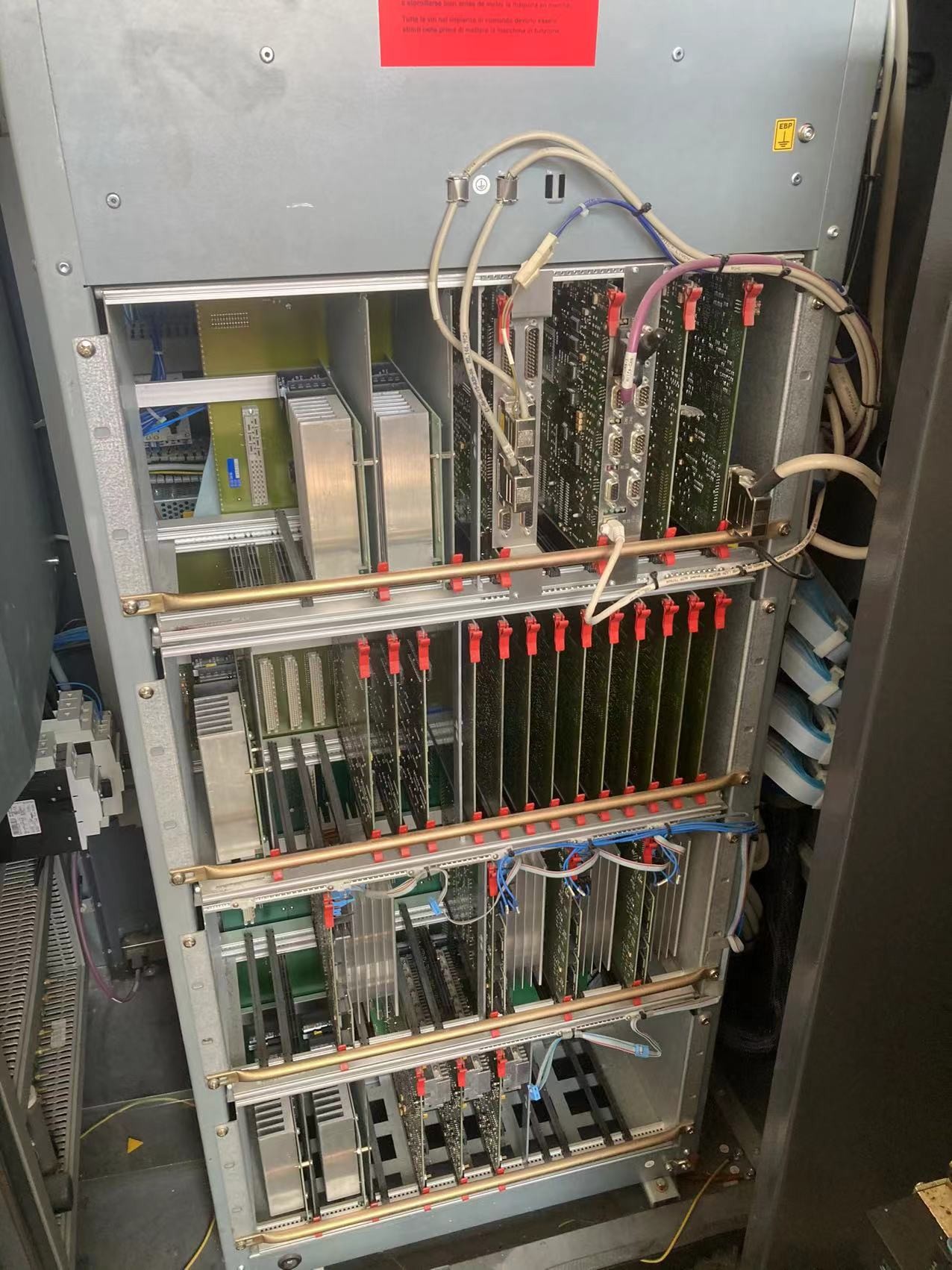
By the 2006 JS2102A, the electrical system centers on a PLC with an HMI for operation, status display and parameter setting; an encoder serves as the machine main-drive signal source, with the PLC counting input pulses at high speed to track machine speed and angle; front-lay interlocking uses a dedicated high-speed PLC channel with momentary high-voltage strong pull-in; and inverter control covers both the main drive and the water roll. The same file sets hard electrical conditions: a three-phase four-wire 380 V, 50 Hz supply whose neutral acts as the protective earth bus and must be well grounded; supply-voltage fluctuation within ±10%; power capacity of at least 40 kVA with an external disconnect required; and, in electrically noisy environments, an interference-grounding conductor with resistance below 100 Ω. These three conditions form ready-made electrical acceptance criteria — a workshop with the wrong supply format, capacity or earthing will surface the faults during installation, not later.
4. Inspection points, common misjudgments and on-site safety
Combined with the data above, an inspection routine for a domestic duplex folio press comes down to six actions:
- Nameplate and serials: compare serial number and build date letter by letter with the auction notice and photograph the stamped serial location. The two Gaotang units left the factory nearly a year apart as consecutive batches of the same model, so component interchangeability between their electrical sets should be confirmed separately.
- Trigger every stop interlock: feed deliberate double sheets, blanks and skewed sheets and watch the ten sequenced responses — feeder stop, upper plate and upper blanket separation, lower-to-upper blanket separation, lower blanket to lower plate separation, inking and dampening rollers lifting off, transfer rollers disengaging, front lay stopping, grippers not closing at the transfer board, counter stop, machine ramping to minimum speed.
- Duplex-specific checks: pressure and packing condition of the upper and lower blanket cylinders; wear of gripper fingers and pads (this model uses single-piece pads that are easy to replace, but check whether oversize wear has already scored the cylinder body).
- Cabinet sampling: verify wiring against wire numbers with no jumper wires or temporary shorts on PLC and encoder lines; main-motor leads must land directly on the gearbox terminal board, incoming supply on L1, L2, L3 and PE, and frame protective earth via braided strap to an unused earthing point at the delivery.
- Common misjudgments: treating the nameplate 9,000 sheets/hour as real output (the file calls it a design ceiling); treating the starting bid as the expected hammer price (the notice makes bidders bear their own auction risk); testing one side only — in duplex mode the two blanket cylinders press against each other, so gear streaks and pressure faults from the lower side never show in a single-side trial.
- On-site safety: viewing lots are usually energized; lock out and tag out before barring the machine or opening cabinets; pneumatic clutches can retain pressure after power-off, so bleed first, then work.
Installation matters just as much: the JS2102A file requires a spirit level accurate to 0.02/1000 mm placed on the wall plates for leveling, followed by grouting the anchor bolts with cement slurry once leveling is accepted. A used press that skips re-leveling and starts printing immediately will typically show axial register drift concentrated in its first production week — by which time the original installer is no longer answerable. For a structured self-check, see the earlier five-point inspection checklist and benchmark against the current stock.
Conclusion: The November disposal calendar shows domestic folio presses now circulate second-hand at scale. For a 2018 Changsheng CSS920 or a mature Beiren JS2102A, specifications, drivetrain traits and control generations are all on record; inspection needs no mystique. Get three things right — channel context, specification criteria and interlock verification — and the data is already in the public technical files; what is missing is only the patience to check them line by line.