

On the used offset press inspection floor, the three words buyers say most often are "there are streaks." When prints show alternating dark and light bands, elongated dots or ghosting, the seller's answer is usually "it's the paper" or "a new blanket will fix it." Judging whether that answer holds up requires understanding where streaks actually come from: they are not an isolated printing defect but the joint projection of gear drive, bearer contact and cylinder bearing preload onto the sheet. This article takes that drivetrain apart and provides field criteria you can check item by item.
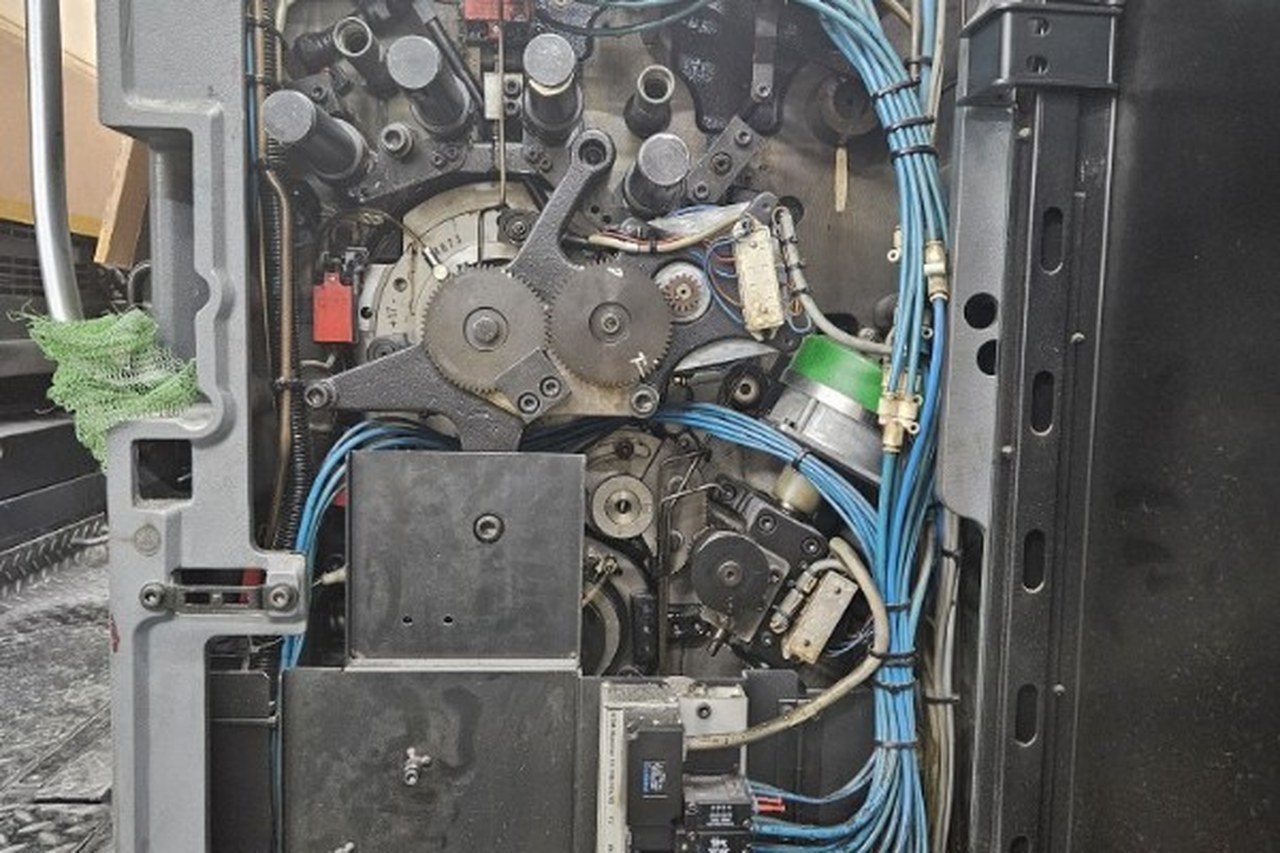
- Print units are driven by gear mechanisms; image transfer from plate to paper relies on a contact line — the printing line — where surface speed must match the circumferential speed exactly.
- Cylinders must be arranged in precise parallel, with matched bearer rings on both sides; bearer contact condition is the first gateway to judging a unit's mechanical health.
- Cylinders run on virtually zero-backlash double-row needle bearings, accurate to a maximum error of 1/1000 mm, with preload set by the manufacturer; backlash-free running is mandatory for perfecting.
- The blanket cylinder must roll against the plate cylinder with extreme precision, and the blanket is tensioned by a worm gear — a slack blanket feeds straight into the ghosting chain.
- On a control strip, cross-direction slurring and circumferential slurring point to different component chains; separate ghosting, tailing and slurring with a loupe before chasing parts.
- Climate counts too: the ideal condition is 20 °C and 50–55% relative humidity, and paper quality, curl, sag or feeder misalignment can all disguise themselves as mechanical streaks.
1. Where streaks come from: speed consistency on the printing line
Dot transfer in offset printing happens on a very narrow contact line. At the moment of impression, the plate, blanket and impression cylinders must present identical circumferential surface speed on that line; any instantaneous speed difference stretches or compresses dots along the direction of travel, producing periodic banding. All unit power comes from the gear train, and the unit also splits off drive for the inking unit, so gear flank wear and mounting backlash map one-for-one onto the printing line. Run the press at production speed with impression on: if the streak pitch is fixed and corresponds to the pitch circumference of a particular gear pair, the drivetrain side is implicated — not the ink or water system.
2. Bearers: matched pairs and contact checks
Matched bearer pairs on both sides are a basic assembly requirement and a reference for detecting improper disassembly. In the field, verify bearer contact with a marking-compound method: apply a thin layer of checking compound, bar the machine over, and read the contact band — it should be continuous and uniform, stepping adjustments in 0.02 mm increments and rechecking every 90° of rotation. Interrupted, one-sided or asymmetric bearer contact indicates that center distances or bearing condition have drifted from factory settings; such machines usually need impression re-setup before normal dot reproduction returns. Bearer checking and impression setting are two faces of the same coin.
3. Bearings and preload: the 1/1000 mm threshold
Modern cylinder mounts are maintenance-free double-row needle bearings, accurate to a maximum error of 1/1000 mm with factory-set preload. The figure sounds severe, yet it is precisely what backlash-free running — and perfecting capability — depends on: once bearing clearance appears, every sheet hand-off shock in perfecting mode is magnified into visible register and streak problems. During inspection, place a dial indicator against the cylinder shoulder and sweep the full rotation; swing beyond the 1/1000 mm order of magnitude, or a hard spot in hand feel, warrants opening the gear-side guard for visual confirmation of bearings and gear flanks. Pitting on gear teeth, oil level and oil condition are mandatory checks in the same step.
4. Reading direction: circumferential streaks, cross slurs and ghosting
Streaks are not one fault but a family. On signal elements, slur magnifies problems visibly: dots stretched along the direction of travel usually implicate cylinder drive, gears or bearings; slurring across the sheet leans toward dampening and inking balance or sheet transport. Ghosting must be separated from slurring with a loupe — an unexpected shadow beside the dot, usually with the dot shrinking, is ghosting. Mechanical items dominate the ghosting cause list: incorrect cylinder packing, a slack blanket, incorrect cylinder rotation, and dirty or defective impression-cylinder grips or other grips. Tailing or set-off describes dot deformation from mechanical causes after printing, plus wet ink transferring to other surfaces. Sort symptoms into chains by direction and morphology before touching anything.
5. Common misjudgments and acceptance actions
Three misjudgments are most common. First, blaming the machine for paper: curled, wavy or slack-sagging sheets produce streak-like impressions; a retest on flat coated stock rules this out. Second, blaming mechanics for climate: once temperature and humidity drift from the ideal 20 °C and 50–55% RH, dimensional stability drops and ghosting probability rises. Third, judging by a single speed: streaks that vanish at one speed are not cleared — gear defects often excite only in specific speed bands. Recommended acceptance sequence: trial print on acceptance stock and read the control strip; open gear-side guards for visual inspection of gears and lubrication; verify cylinder radial runout with a dial indicator; finally confirm blanket tension and packing data against the model specification.
| Print symptom | Directional signature | Check first | Field action |
|---|---|---|---|
| Periodic circumferential streaks | Fixed pitch along feed direction | Gear backlash, bearing clearance | Speed-sweep retest + dial-indicator sweep |
| Cross-direction slur | Perpendicular to feed | Ink/water balance, transfer stability | Re-balance dampening, retest strip |
| Ghosting | Shadow beside dot, smaller dot | Packing, slack blanket, grips | Loupe reading + re-tension blanket |
| Tailing / set-off | Oval dragged dots | Hand-off grips, delivery anti-marking | Check grip cleanliness and powder |
Much of the value gap between used presses hides in this drivetrain. Machines with sound gears, bearers and bearings consistently outperform mechanically loose sisters with identical spec sheets; conversely, streak reading becomes a basis for price negotiation rather than a reason to walk away.
Conclusion: Streak reading is a reverse diagnosis of speed consistency on the printing line — attribute by direction first, then work through gear drive, bearer matching, bearing preload, blanket tension and grip condition, with a control strip, a loupe and a dial indicator as the only tools you need. No streak on the inspection floor has to remain unexplained.