

Since mid-October, used offset press inquiries have been shifting outward: alongside domestic showroom traffic, Southeast Asian buyers have become noticeably more active. Dealers near ports such as Qingdao and Guangzhou now bundle recovery, refurbishment, packing, ocean freight and customs clearance for retired Japanese, Korean and European machines into one service, and even a single-color Heidelberg Kord 64 — 460 x 640 mm maximum sheet, 380 V — is listed on cross-border marketplaces with buyers concentrated in Saudi Arabia and the Philippines. The direction is sound, but between a domestic workshop and an overseas print shop a used machine must clear three gates: pre-shipment inspection, anti-corrosion packing, and on-site re-commissioning. This article walks through each in order.
- Used machinery imports are managed under three categories — prohibited, restricted and permitted — and second-hand presses fall under pre-shipment inspection: the certificate must be issued before loading and its number quoted in the customs declaration, or the cargo cannot clear the port of arrival.
- For Vietnam, used presses are generally capped at 10 years of age, with residual performance of at least 85% of design values and energy consumption no more than 15% above design; import is for own production only, not resale.
- The Vietnamese import license (IQ) takes roughly 7-10 working days to approve; do not ship before it is granted.
- Ocean packing has an explicit factory standard: overseas consignments travel in cases with VCI anti-corrosive treatment sealed under PVC foil to establish a protective atmosphere against humidity and shock.
- Presses are designed for a 400 V AC working voltage; where the supply neutral is earthed, 380 V, 400 V or 415 V three-phase can be connected directly, but supplies below 380 V or above 415 V (480 V) require a series transformer — and an isolating transformer where 480 V has no earthed neutral.
- Wooden packing must carry IPPC fumigation marks; precision parts travel separately with desiccant, and bracing in open-top or flat-rack containers runs roughly USD 800-1,200 per unit.
Gate one: pre-shipment inspection and eligibility
Two concepts first. The definition of used machinery is broad: equipment in use but still serviceable, unused but past warranty, mixed new and old parts, or refurbished — all count. Import management splits into prohibited, restricted and permitted classes keyed to the customs commodity code; a wrong code voids the whole plan. A common misconception deserves clearing up: the importing side imposes no blanket ten-year limit — only items on the key used machinery catalog carry age restrictions. Export direction is different. ASEAN markets such as Vietnam and Indonesia generally hold used machines to a ten-year cap with the 85% performance and 15% energy thresholds, which makes the nameplate — model, serial number, year of manufacture — a hard precondition; a faded or missing nameplate fails both inspection and customs valuation.
The Vietnamese document chain runs: condition statement (build date, years used, remaining-value ratio), full-machine and nameplate close-up photos, bilingual technical parameters, plus the pre-shipment inspection certificate, all feeding the Ministry of Industry and Trade import license. Inspection is usually booked 5 to 10 days before shipment and covers safety guards, environmental compliance (no asbestos, no fluorinated refrigerants) and nameplate authenticity. A detail easily missed: spare lithium batteries or large capacitors inside the machine must be screened out with a non-hazardous declaration before inspection, or the whole consignment stalls. A Form E certificate of origin, authenticated by the exporter's chamber of commerce and valid for one year, lets the Vietnamese buyer claim preferential ASEAN tariff rates.
Gate two: what proper ocean packing really means
Sellers often assume export packing is just a wooden crate, but the factory standard is more graded: overseas consignments go in cases, while domestic, intra-European and containerized shipments have the press bolted to pallets under plastic covers. Overseas case sides carry markings so the crates can be oriented correctly at unloading. The core of rust prevention is VCI treatment sealed under PVC foil: a specific micro-atmosphere under the film suppresses corrosion on machined surfaces across weeks of salt-laden, humid transit. The standard applies equally to refurbished machines re-entering the export market — skip the anti-corrosion seal and two or three weeks at sea can leave guide rails and cylinder mirror finishes spotted with rust, a genuine deduction at the buyer's inspection.
The subtler hazard is condensation. A press shipped from a northern winter and uncrated immediately in a tropical workshop hits a temperature shock: the body sits below the dew point and moisture precipitates on the foil; without the foil it forms directly on finished metal parts and oxidizes them. The correct procedure is to leave the foil untouched until press and pressroom temperatures have assimilated — at least 12 hours. Transit warehouses and receiving plants across Southeast Asia should write this waiting window into the handover sheet.
Gate three: electrical and foundation work on arrival
Arrival is not the finish line; re-commissioning is where failures cluster. Electrically, presses are designed for a 400 V AC working voltage: with an earthed-neutral supply, 380 V, 400 V or 415 V three-phase connects directly; below 380 V or above 415 V — 480 V appears in some plant districts — the customer must fit a series transformer, and an isolating transformer where 480 V lacks an earthed neutral. The supply cable to the series transformer and from it to the central control cabinet must be copper and is not supplied with the machine — budget for it. The matching power units on Roland 700 presses tolerate wider spread: three-phase 380 V AC within +20%/-15%, or 500 V AC within +10%/-15%; but if a line-side fuse drops a phase, the unit flags fault F04 and refuses to start — a real consideration where grid voltage sags.
Foundations and levelling carry hard numbers: the foundation must be dimensioned to the actual machine weight, and where in doubt a structural engineer should verify it; door widths and transport routes must be checked against machine dimensions before dispatch. Levelling uses a 0.02 mm/m precision spirit level with the floor's highest point as reference; printing-unit levelling feet are pre-set to 204 mm, with a different preset for coating units, and every foot is checked for solid seating afterwards. Data and control lines must be routed separately from power supply lines — a rule that bites hardest in older, informally wired Southeast Asian plants.
Nameplates: one label, three uses
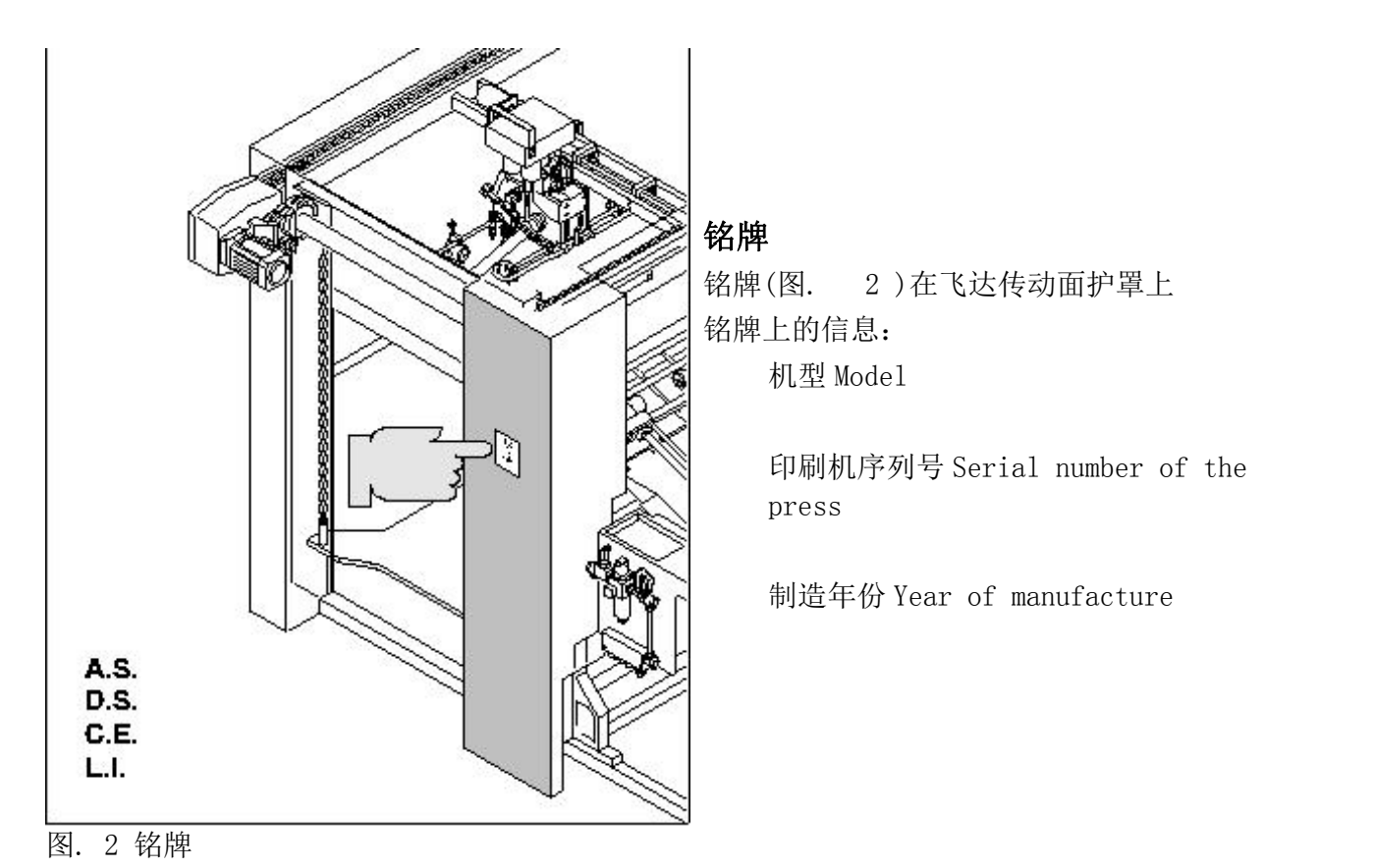
The nameplate appears three times on the export chain: pre-shipment inspection verifies its authenticity, customs valuation checks it against original-value documents, and service teams use it as the master key for spare-parts lookup. On Heidelberg SM/SX102 presses the nameplate sits on the feeder drive-side guard with model, serial number and year of manufacture, while the serial-number stamp sits on the side frame inside the delivery. Buyers should reconcile the nameplate against contract and inspection certificate word for word and question any sign of alteration. Two misjudgments recur: treating a missing nameplate as cosmetic when inspection will block outright, and reading age alone while ignoring running hours — an eight-year-old machine on triple shifts can be more worn than a lightly used fifteen-year-old, and the 85% performance line is proven by test-print data, not paperwork. On safety, electrical re-connection is qualified-electrician, power-off work under local regulations; the installation documentation marks it as a bolded warning clause.
The realistic window from purchase to re-commissioned production runs about 45-60 days: documentation and licensing in parallel for 15-25 days, inspection and booking 5-10 days, ocean freight and clearance 15-20 days, plus roughly a week for levelling and commissioning. Buyers should put the three routinely forgotten cost items — special-container bracing, series transformer, fumigated packing — on the table at negotiation, or the landed-cost overrun will erase the price advantage of buying used.
Conclusion: Exporting a used offset press is not finished when the container doors close. Pre-shipment inspection decides whether it can leave port; VCI packing and the 12-hour condensation window decide its arrival condition; the series transformer and 0.02 mm/m-grade levelling decide whether it starts production on the first attempt. Each gate has its evidence: the inspection certificate, the packing record, the commissioning acceptance sheet. Move all three ahead of contract signature, and the export trade becomes a genuinely closed loop.
Browse current stock and inspection services in the equipment for sale section; for buyer risk control in bankruptcy auctions, see the earlier auction risk-control guide.