

The feeder is the first gate of a sheet-fed offset press and the area most likely to reveal a machine's real maintenance history during a used-equipment inspection. The Heidelberg CD102/SM102 Preset Plus Feeder integrates the suction belt, automatic pile-height control and the pneumatic valve circuit in one module. Wear or contamination in any of these three paths shows up immediately as skewed sheets, doubles, misses or wrinkles. This guide turns the factory maintenance logic into a practical preventive checklist that buyers and pressroom crews can use both before purchase and during daily operation.
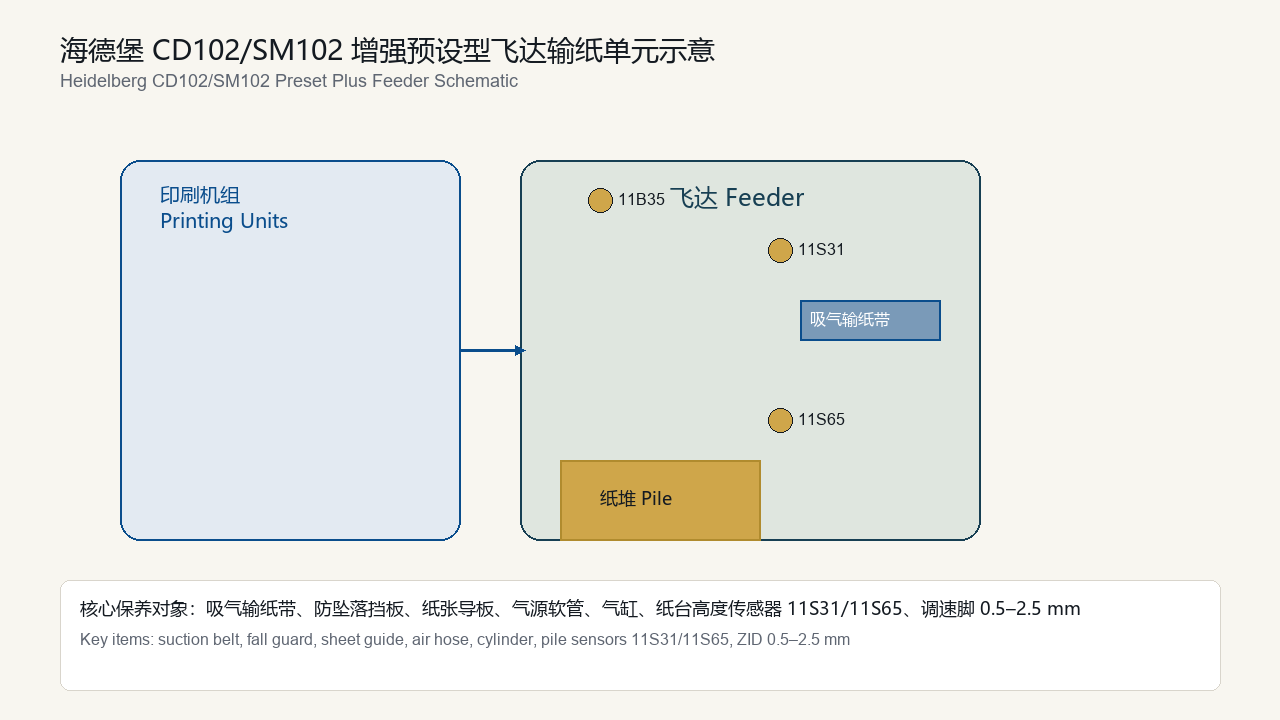
- Suction belt: the main traction element in the feeder. Once worn, it loses vacuum and sheets slip. Replacement must follow the tension marks; over-tensioning damages bearings.
- Pile-height control relies on main-pile motor 11M1, auxiliary-pile motor 11M2, suction-head limit 11S31, main-pile high/low limits 11S33/11S34, pile-auto-run sensor 11B35 and the adjusting foot 11S65; the ZID compensation range is 0.5–2.5 mm.
- Pneumatic circuit cleaning focuses on the IPU suction unit, LPU low-pressure unit, PU1 valve group and valves such as 00.580.5334/01; condensate should be drained and filters checked weekly.
- Preventive intervals should be split into daily, weekly, monthly and yearly tasks; for a newly acquired used press, run the first month at half the normal interval to learn the true wear rate.
- On-site acceptance criteria include belt tracking, smooth pile travel, sensor LEDs switching with pile height, and no audible air leaks at fittings.
Suction Belt Replacement: Standard Procedure and Tension Rules
Replacing the suction belt on the Preset Plus Feeder is a one-hour job with a defined tool list: a set of hex keys, a drift pin, a rubber hammer and a screwdriver for the fork-head fasteners. The first step is lockout/tagout: turn the press power switch off, lock it and attach an authorized-operator tag. If the machine is fed from an in-house compressed-air line, close the supply to the press and open the condensate drain at the feeder's maintenance station to bleed residual pressure from the receiver and lines.
Remove all paper from the feed pile, raise the feed table on the operator side and open the feeder service door. Next take off the fall guards on both the drive and operator sides, each held by three screws. Roll the suction-belt drive roller until the clamping screws are accessible, loosen the clamping seats and remove the roller sections. Disconnect the air hoses and clamps, then lift the suction-belt module out of the frame.
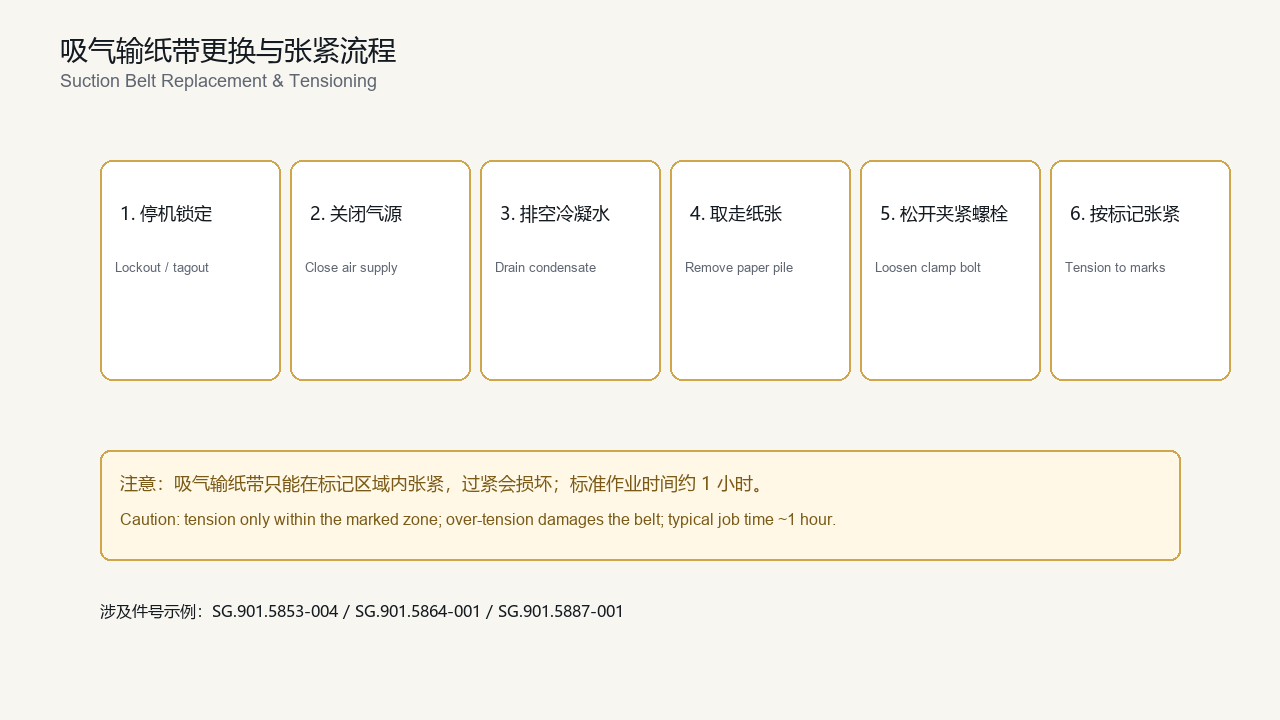
When fitting the new belt, pay strict attention to the tension marks. The module has alignment marks, and the belt has matching hole marks. Seat the belt in the center, loop it over the guide rollers, then shift the belt so the first and second hole marks line up with the module marks. Tension only within the marked zone; the module explicitly warns that over-tensioning will damage the belt. During a used-press inspection, a belt that has drifted outside the marks or shows cracks and fraying is a clear sign of deferred maintenance and should be priced as a replacement item.
Pile-Height Control: Cleaning and Calibration
The automatic pile-height system is governed by drive motors 11M1 (main pile) and 11M2 (auxiliary pile), protected and triggered by limits 11S31, 11S33, 11S34 and slow-motion switches 11S39/11B54, plus the pile-auto-run pair 11B35/11S35a. The adjusting foot 11S65 keeps the pile top edge level with the suction head, with a ZID compensation span of 0.5–2.5 mm.
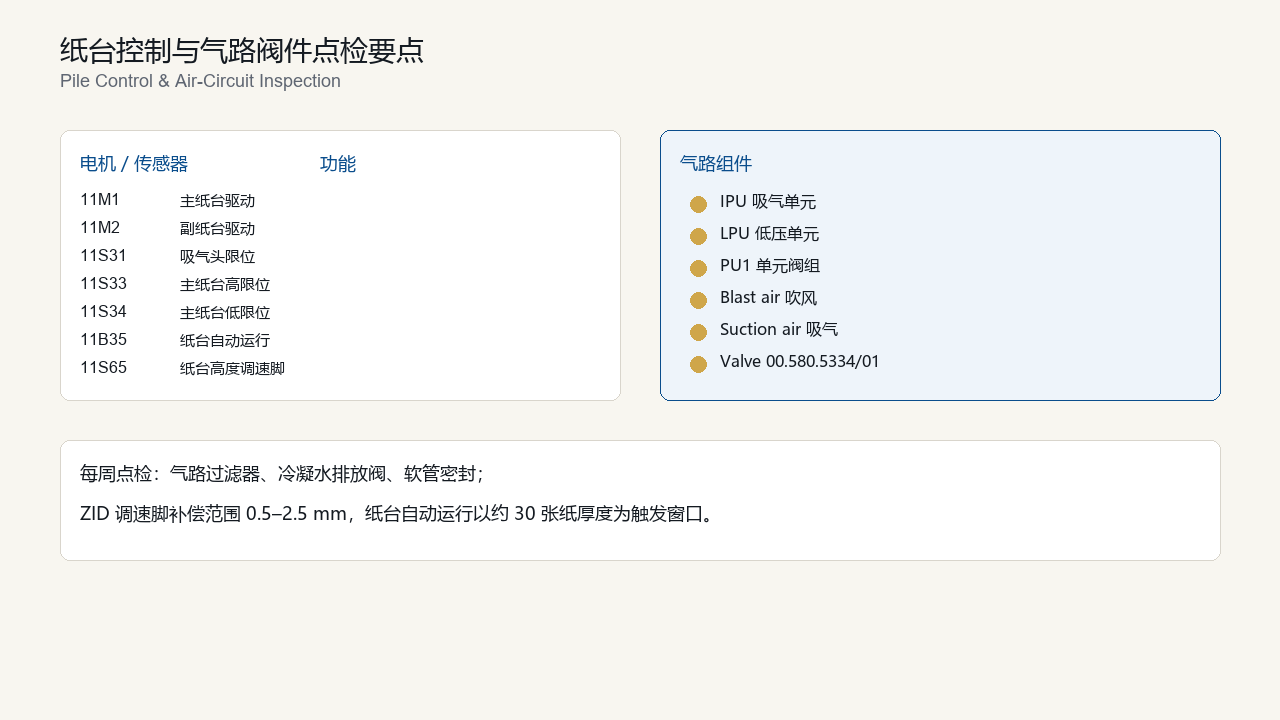
Maintenance has three layers. First, keep the sensors clean: 11B35 and 11S35a trigger within roughly a 30-sheet window. Dust or paper coating on their faces makes the pile stop early or fail to lift. Blow them off weekly or wipe with a lint-free cloth. Second, test the limits: 11S33 and 11S34 must snap cleanly; when the pile-stop button is pressed, motion should halt instantly. Any delay points to worn contacts or loose terminals. Third, recalibrate the ZID range whenever paper thickness changes or after long runs, confirming that the 0.5–2.5 mm band still covers the current stock. Otherwise thin sheets will not lift and thick sheets will collide with the suction head.
Pneumatic Circuit Cleaning and Valve Inspection
The feeder pneumatics split into blast and suction paths, centered on the IPU suction unit, LPU low-pressure unit, PU1 valve group and valves such as 00.580.5334/01. The main contaminants are condensate, paper dust and ink powder, which settle in valve spools, hose fittings and filters, reducing airflow and causing sticking. Weekly maintenance means draining every condensate trap in the feeder, inspecting suction and supply hoses for cracks or looseness, and cleaning or replacing the filter element.
Two quick field tests help. Listen: normal suction should be steady and even. Pulsing airflow or whistling usually means a blocked filter or a leaking hose. Feel: at low speed, hold the back of your hand near the valve outlets to sense the blast/suction cycle; a valve that never actuates likely has a coil or connector fault. On a press that has been idle, always vent the lines at no-load before full operation; trapped condensate can jam a valve the moment it energizes.
Maintenance Schedule and Used-Press Acceptance Advice
The work above fits into a four-level schedule. Daily: visually check the belt for cracks or tracking errors, clear paper debris around the pile, drain condensate. Weekly: clean 11B35/11S35a/11S31 faces, inspect pneumatic hoses and fittings, verify the ZID value. Monthly: check belt tension marks, test main and auxiliary pile limits, clean filters. Yearly: replace the suction belt, inspect drive-roller bearing play, and calibrate all pile-height sensors.
For a used Heidelberg CD102/SM102, run the first month at half these intervals because the previous owner's habits are unknown; frequent checks will surface hidden problems faster. Before purchase, focus on three things: whether the belt has drifted from its marks or shows heavy wear, whether the pile lifts smoothly and the limits respond crisply, and whether oil-soaked dirt or water stains around pneumatic fittings indicate long-term leakage. If all three are clean, the feeder is usually in acceptable condition. If two or more are off, budget for the belt, sensors and the pneumatic service kit.
Conclusion: Feeder maintenance is not complicated, but it only works when suction-belt tension, pile-height sensing and pneumatic cleaning are kept on the same schedule. With daily, weekly, monthly and yearly checks closed into a loop, a used CD102/SM102 can keep misfeeds low and deliver stable output from the very first pile.