

On October 12, the 10th All in Print China opened at the Shanghai New International Expo Centre under the theme of intelligent and unlimited printing. The show covers 120,000 square meters, a record high, gathering more than a thousand exhibitors from China, Germany, Japan, the United States, Belgium and other countries, and expects over 120,000 trade visitors from more than 130 countries and regions. More than one hundred new products are debuting, including high-speed wide-format inkjet presses, integrated intelligent packaging lines, inline visual quality inspection and digital workflow platforms. For the new-machine market this is a technology bellwether; for buyers and sellers of used offset presses it raises a more practical question: as new presses go fully digital, which rung of the technology ladder does a five-, ten- or twenty-year-old press actually occupy? This article traces the generational evolution of press control systems and turns it into a practical valuation lens for the used market.
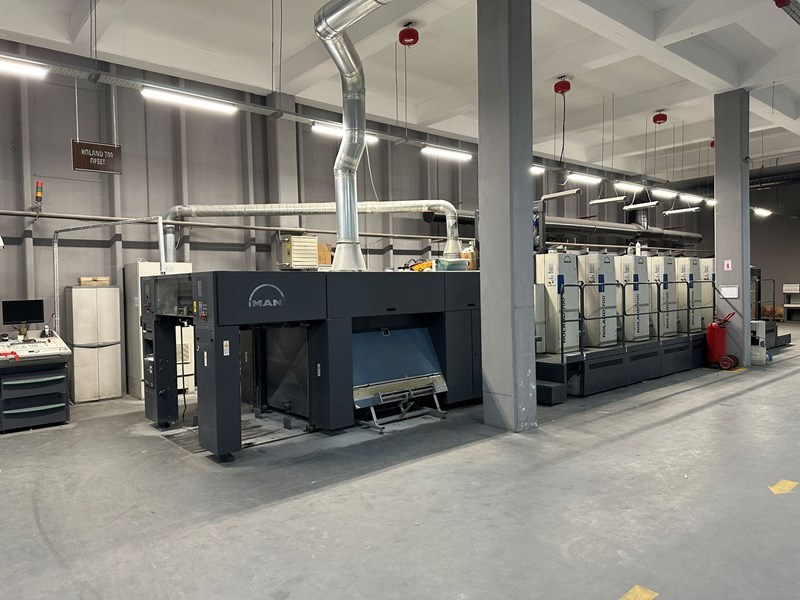
- The show spans 120,000 square meters with over a thousand exhibitors and 120,000 expected visitors; more than 100 new products debut on site.
- Debut directions center on high-speed wide-format inkjet, intelligent packaging lines, inline visual inspection and digital workflow control, with AI-enabled end-to-end collaboration as the core narrative.
- Used press valuation is shifting from age plus impression count toward the data-interface generation of the control system.
- As early as 1989, onboard quality-control systems already offered magnetic-card readers, floppy-disk data storage and job-number error codes.
- Whether a used press can still run productively for years is best judged by whether it exchanges preset data and production history bidirectionally with a central workflow system.
1. What the new presses at the show are doing: AI collaboration and inline inspection
Across exhibitor releases and show coverage, the emphasis has moved beyond printing speed. High-speed wide-format inkjet targets scalable variable-data production; integrated packaging lines chain printing, die-cutting and gluing into one flow; inline visual inspection hands color, register and defect judgment from manual sampling to cameras and algorithms. A dedicated demonstration zone for intelligent printing equipment frames four trends: scaled adoption of inkjet, high-end upgrading of post-press packaging equipment, AI-enabled end-to-end collaboration, and the accelerating rise of domestic equipment. Fact and judgment should be separated here: these are verifiable show facts, whereas a claim that the new technology will depress used offset prices within two or three years is a judgment — value transmission is gradual, and its real mediator is the control-system generation described below.
2. The digital starting point is older than most buyers think: cards, disks and error codes in 1989
Period service documentation for Komori’s PQC-III print quality controller around 1989 already describes a complete troubleshooting system: the job-number display on the control panel raises Error 01 and Error 02 after reading magnetic-card data, floppy read/write faults have their own problem entries, and the magnetic-card reader itself gets a dedicated chapter covering card jams and a reader motor that keeps running after ejection. Ink-key openings and water settings were already storable, transferable digital assets on magnetic cards and floppy disks more than three decades ago, and plate register could return precisely to 0.00 after a reset. For used-equipment buyers the lesson is direct: a 1990s press that was never fitted with even the card/disk data options was born with an incomplete digital foundation.
3. 2003 to 2005: control systems go online and presets become plant assets
Service documentation for the 2003-generation PQC-IV shows a console that remotely controls ink fountain keys, ink feed, dampening and plate register in three degrees of freedom — circumferential, lateral and skew — with some SP-series presses adding transfer-cylinder skew. Preset values are stored on floppy disks or magnetic cards, and the console can connect to higher-level systems such as PDC and KMS. Its applicability table covers the L-40 and L-44 families from two to eight colors, with features gated by serial-number ranges. By the mid-2000s, the KMS print management system had shaped a full plant-level workflow: job lists and job history let every job’s schedule and preset data be archived, reused and filed into per-project subfolders; presets move bidirectionally between KMS and the press console, with transfers aborted and logged when the console is busy or locked; the system estimates job completion from start time plus a run-time allowance of 30 minutes and produces productivity reports per job. In today’s used market these machines trade at a premium over pre-network presses, and that premium is essentially the price of the data link.
4. Buyer practice: three interface-generation questions instead of judging by cosmetics
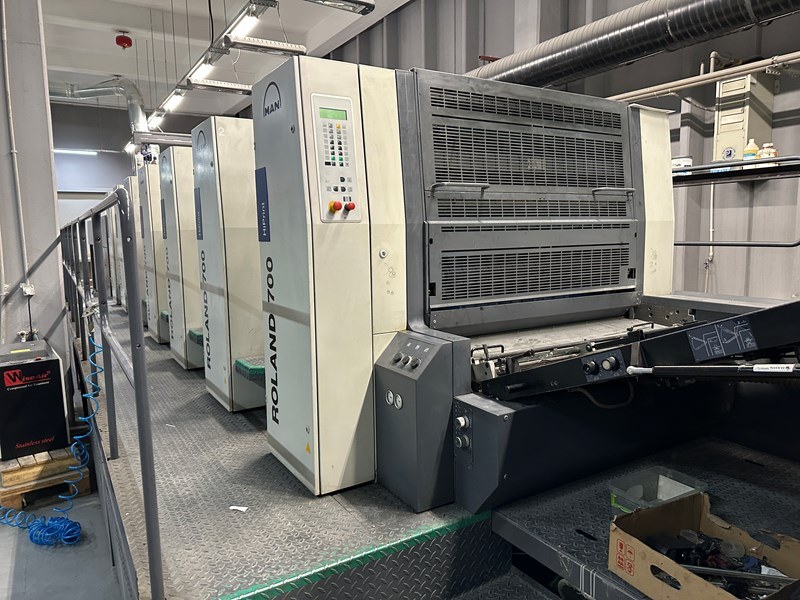
Condensed for shop-floor use, the valuation method is three questions. First, what medium carries the presets — magnetic card, floppy, network file or central server? The newer the medium, the cheaper the integration with modern digital scheduling. Second, does data flow both ways? A one-way system that loads presets but never returns production history deserves a discount; a system that syncs bidirectionally with logged transfer exceptions merits the network-generation premium. Third, do the feature set and serial-number range match? Within the same family, functions were enabled progressively by serial range, so two presses of the same year can belong to different feature batches — verify the nameplate serial against the applicability table during inspection.
| Generation | Representative system | Data medium | Typical capability |
|---|---|---|---|
| Late 1980s | Onboard quality control | Magnetic card, floppy disk | Remote ink/water keys, job-number error codes, register reset to zero |
| Circa 2003 | Fourth-generation console | Floppy/card plus host link | Three-DOF register control, link to PDC and KMS |
| Circa 2005 | Plant-level print management | Central database and file paths | Job history, bidirectional presets, productivity reports, exception log |
| Today | AI workflow platforms | Cloud and inline sensing | Inline visual inspection, digital workflow control, closed data loop |
Two common misjudgments deserve caution. One is converting show enthusiasm directly into panic pricing — in reality SMB press-replacement cycles run in five-year spans, and new technology reaches the used market only after delivery, process validation and volume adoption. The other is paying a premium for a smart label without verifying that the data interface actually works: during inspection, demonstrate a preset save-and-transfer live and confirm the exception log is retrievable. A safety note: interface operations during commissioning must be done by trained personnel — hot-plugging legacy storage modules can damage the main board, and such damage is a liability gray zone in used transactions. The acceptance criteria for perfecting configurations and the current equipment listings are useful extensions for inspection work.
Conclusion: The show displays the industry’s next rung, while used-market pricing is being rewritten by the data-interface generation of press control systems. Rather than fearing new launches, buyers should add three items to the checklist: what medium the data uses, whether it flows both ways, and whether the feature serial-range matches. With these three answers, pricing a magnetic-card press from the 1990s or a networked console from 2005 becomes an evidence-based exercise instead of an emotional reaction to exhibition headlines.