

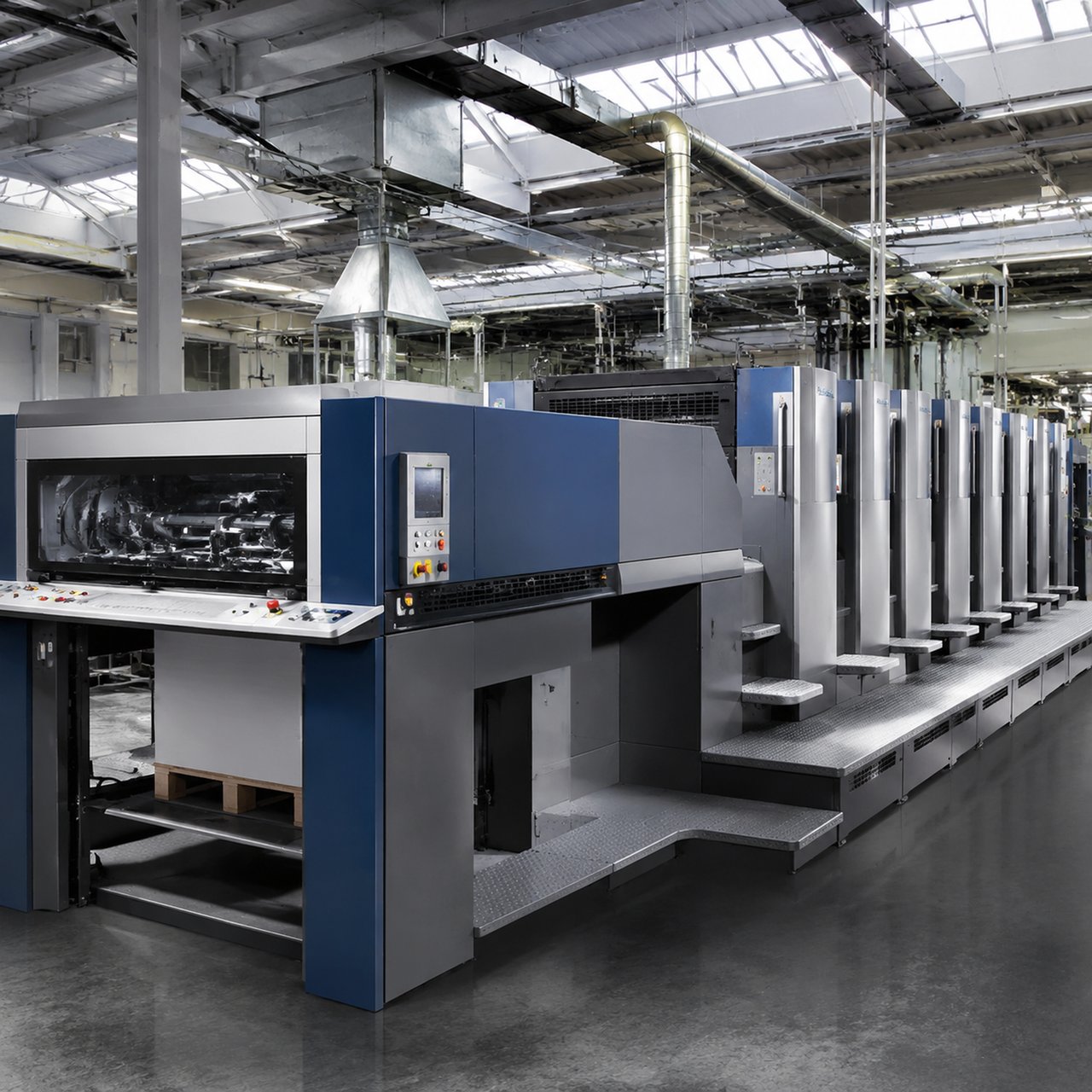
On a used offset press, the lubrication system is the most honest witness. However bright the covers look, they cannot hide the real state of the oil circuits: how many oil changes were done, which oil went in, and how alarms were handled — all of it is written into the wear of bearings and gears. The difficulty for a buyer is that lubrication trouble rarely shows up as something broken; it shows up as maintenance that was skipped. The skipped oil changes come back with interest during the first major overhaul after handover. This article lays out intervals and field criteria for four areas: circulating oil, ink-drum motor gearboxes, main-motor bearing grease and lubrication alarms.
- First change at 200 hours: after commissioning or a rebuild, the circulating oil must be renewed at 200 operating hours, and the confirmation sheet must log press model, serial number and oil grade.
- Two levels, 500 and 2000 hours: circulating-oil changes follow two intervals; every change requires replacing the oil filter elements and refilling to the middle of the sight glass.
- Ink-drum motors every 1000 hours: the gearboxes take their own oil change through drain, vent and control screws, filled until oil escapes at the control port.
- Main-motor grease follows speed: with regreasing devices, the interval compresses from about 7500 operating hours at 1000 rpm to 1500 hours at 3000 rpm, using 50 to 75 g of lithium-base bearing grease each time.
- Alarms have numeric thresholds: 1 bar of circulating pressure within 75 seconds of start-up; 1 litre per minute of oil flow within 60 seconds on small-format presses.
- Run-on is limited: after acknowledging a lubrication alarm the press may turn about 400,000 impressions more — a window for service, not for output.
Oil change intervals: one sheet, two circulating cycles
Manufacturers are strictest about the first change. The sheet shipped with the press states it plainly: after 200 operating hours, carry out the first oil change of the circulating lubrication; follow the maintenance instructions, fill in the sheet and return a copy — the warranty depends on receiving the complete protocol. The sheet records press model and serial number plus the make and product name of the oil used. The same applies to a machine re-commissioned after an overhaul, which is why this single page is the most valuable paper to find when inspecting a used press: it proves the first owner finished the run-in period by the book.
After that, circulating-oil changes follow two levels. Take a service schedule based on three shifts at 80 working hours per week: the first change at 500 operating hours, the second at 2000, both performed identically — lock out at the drive side under the walkway, extract the old oil with a pump through the filler port, drain each unit through its drain screws, retighten with new copper sealing rings, then refill until the oil reaches the middle of the sight glass. Because the units are interconnected, one sight glass represents the whole press. Both changes require replacing the filter elements at the same time; after reassembly, run the press for 15 minutes and recheck sealing and level. Daily checks have a rule too: read the sight glass only after at least 15 minutes at rest; if the level is low, hunt the leak before topping up.
| Task | Interval | Key actions |
|---|---|---|
| First circulating-oil change | 200 operating hours (new or rebuilt) | Change oil, file the sheet with oil make and grade |
| Circulating-oil change | 500 and 2000 operating hours | Extract, drain, new copper rings, fill to mid sight glass |
| Oil filter elements | With every circulating change | Replace, run 15 minutes, recheck sealing |
| Ink-drum motor gearbox oil | 1000 operating hours | Drain, vent and control screws; fill until overflow |
| Main-motor bearing grease | 1500 to 7500 hours (speed-dependent) | Regrease while running, 50 to 75 g lithium grease |
| Oil level check | Daily | Read after 15 minutes at rest; leak first, top-up second |
Oil specifications: viscosity grades must not be mixed
The lubricant chart pins an oil to every point. Circulating lubrication uses a mineral oil with 90 to 110 mm2/s at 40 degrees C; the central lubrication of the delivery chain and the oscillating roller gears use ISO-VG 460; the coating supply system uses ISO-VG 150; the built-in compressor uses ISO-VG 46; motor oil baths use ISO-VG 220 or 460 depending on frame size. Greasing points carry color codes: red daily, yellow weekly, white monthly, orange every six months, blue yearly — roughly 16, 80, 380, 2280 and 4560 working hours. The wrong viscosity can trigger repeated alarms, and damage caused by unspecified lubricants is excluded from the manufacturer's liability. On an inspection, a glance at the oil drums and recent top-up records says more than any sales talk. Manual points come as counts: two to three strokes of oil or eight to ten strokes of grease with a hand gun, and surplus lubricant must be wiped off so it never reaches the sheet path or the ink system.
Ink-drum motor and main motor: two independent cycles
The ink-drum motor gearboxes have their own schedule, every 1000 operating hours, with three screws: open the drain screw and let the old oil out, close it, refill through the vent screw until oil escapes at the control-screw port, then retighten all three; do this for both the upper and lower motors. While changing, check the gear chamber for bright particles — if you find any, chase the bearings.
Main-motor bearings follow a different logic. Smaller frames are permanently lubricated and maintenance-free; larger frames carry regreasing devices, and the interval compresses with speed — for the same 225 frame, about 7500 operating hours at 1000 rpm but 1500 hours at 3000 rpm, with roughly 50 g per regreasing, 65 g for the 250 frame and 75 g for the 280 frame. The grease itself is specified: a lithium-base saponified rolling-bearing grease. Two details are done wrong most often: motors with regreasing devices must be regreased while running — static greasing pushes fresh grease to the wrong side — and motors without such devices need a complete grease change at least every three years. Ventilation filters must be cleaned every 100 operating hours; a clogged filter raises the winding temperature until the motor trips.
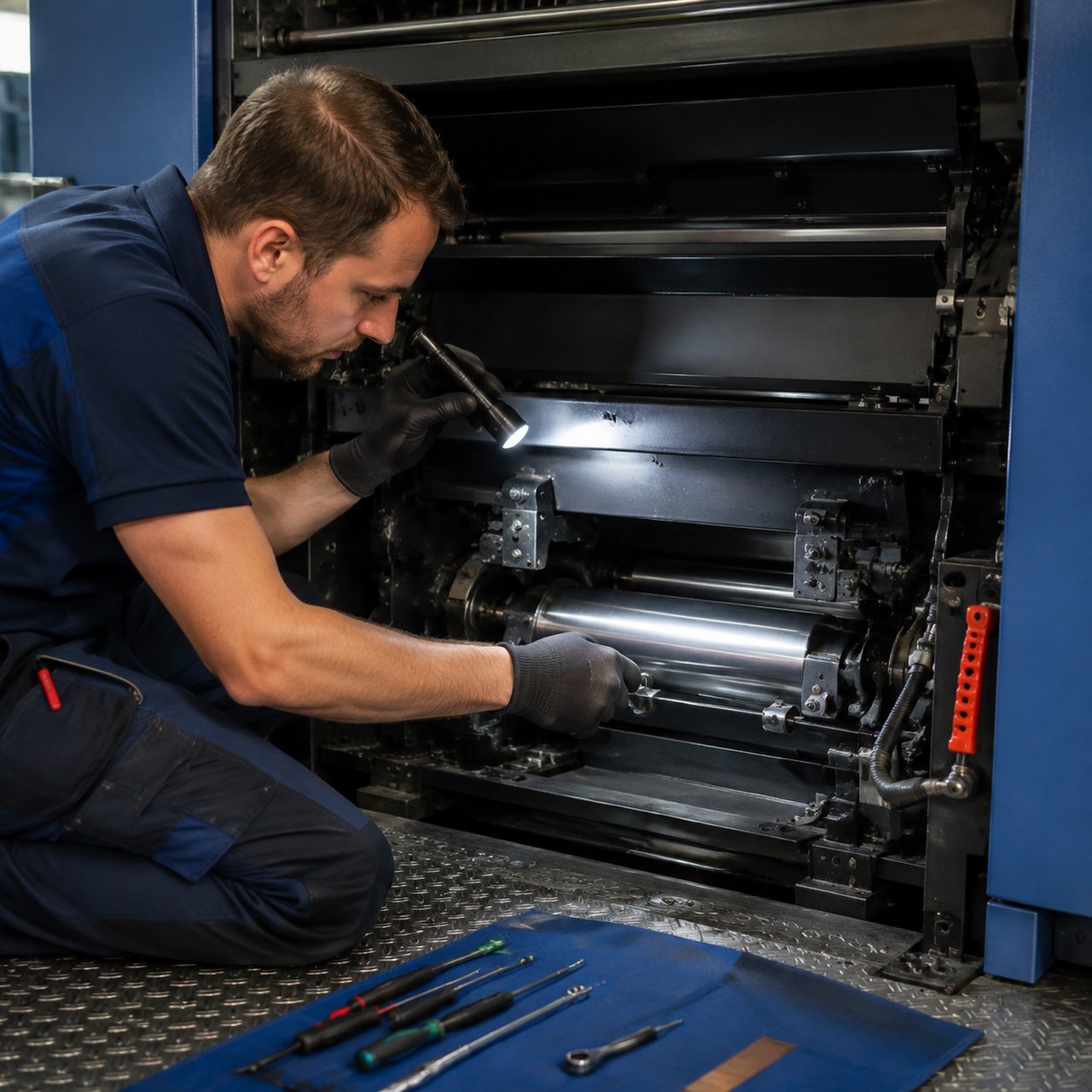
Reading lubrication alarms: pressure, flow and the run-on allowance
Lubrication alarms come with numbers. In a typical central system, circulating lubrication must build 1 bar within 75 seconds of start-up; if pressure drops below 1 bar for more than 15 seconds in operation, the system locks the feeder and enters emergency mode. After acknowledging, the press may run on for 400,000 impressions before the main drive is disabled — that allowance is a window for troubleshooting, not for production. Small formats monitor flow instead: 1 litre per minute within 60 seconds, alarm when below 1 L/min for more than 5 seconds. Large-format delivery lubrication demands 20 bar within 180 seconds, with the run-on allowance cut to 250,000 impressions. Cold, thick oil can fake a filter-dirty message; let the press warm up and it clears by itself — on a winter morning, warm first, touch nothing yet.
Another class of codes points straight at filters. The Roland 700 series carries its own diagnostics for the coating module's circular lubrication: 31319 — required oil pressure not reached, with causes ranked as oil shortage, contaminated oil filters and control trouble, and remedies that boil down to filling the container and cleaning or exchanging the filter; 31320 — the suction strainer is blocked; 31321 — the pressure filter is dirty. All three converge on the same thing: filter condition. When they appear, check oil level first, filter condition second, control loop last.
| Alarm | Threshold | Consequence |
|---|---|---|
| Circulating pressure (1 bar monitor) | Within 75 s at start-up; below for over 15 s in run | Feeder lock plus emergency mode; 400,000-impression run-on after acknowledge |
| Oil flow monitor | 1 L/min within 60 s; below for over 5 s | Alarm, flow monitor switched |
| Delivery high-pressure lubrication | 20 bar within 180 s | Emergency mode; main drive disabled after 250,000 |
| Oil level low | Level switch | Refill through strainer; find the leak first |
| Filter dirty | Differential switch | Replace element; a cold-oil false alarm clears when warm |

Common misjudgements and site safety
The three costliest mistakes: resetting alarms again and again without looking at the oil level — what wears out is the bearing, the alarm is only the messenger; topping up straight after a cold start, so the level reads too high once oil drains back, and oil reaching clutches and belts becomes the next fault; and pouring fresh oil without the strainer, feeding dirt directly into the circuit. Schedules couple the oil change and the filter change in one step precisely so that new oil is not re-contaminated by the old element. Site safety rules are equally hard: lock out the main switch before draining; beware hot surfaces and hot oil; after aerosol lubrication, ventilate for 15 minutes before restarting; dispose of waste oil and spent elements properly. And wipe off surplus grease — over-lubrication harms as much as under-lubrication.
Used-press inspection: six lubrication checks
Turn the intervals and thresholds into actions. First, look for the 200-hour confirmation sheet and later oil-change records, and check that oil brands were logged consistently. Second, read the sight glass after 15 minutes at rest: the level should sit mid-window; milky oil means water, dark brown with shiny particles means bearing wear. Third, check oil drums and recent top-ups against the lubricant chart. Fourth, run the pump and listen; ask whether the pump-motor breaker has ever tripped. Fifth, go through the alarm history and count lubrication alarms, watching for run-on allowances used to the limit again and again. Sixth, survey for leaks: renewed copper rings at drain screws, oil sludge around filler ports and sight glasses. When all six come back clean, the lubrication system has truly been handed over. You can take this checklist along when browsing our used offset presses.
Conclusion: There is no mystery in lubrication — only intervals, oil grades and numeric thresholds. The 200-hour first change builds trust, the 500 and 2000-hour cycles keep the circuits alive, ink-drum motors get their own 1000-hour change, and main-motor grease intervals compress with speed and must be done while running. One bar, 75 seconds, one litre per minute, 400,000 impressions — these numbers draw the line between alarm and action. On a used press, a complete set of oil-change records is more convincing than a machine polished bright.


